


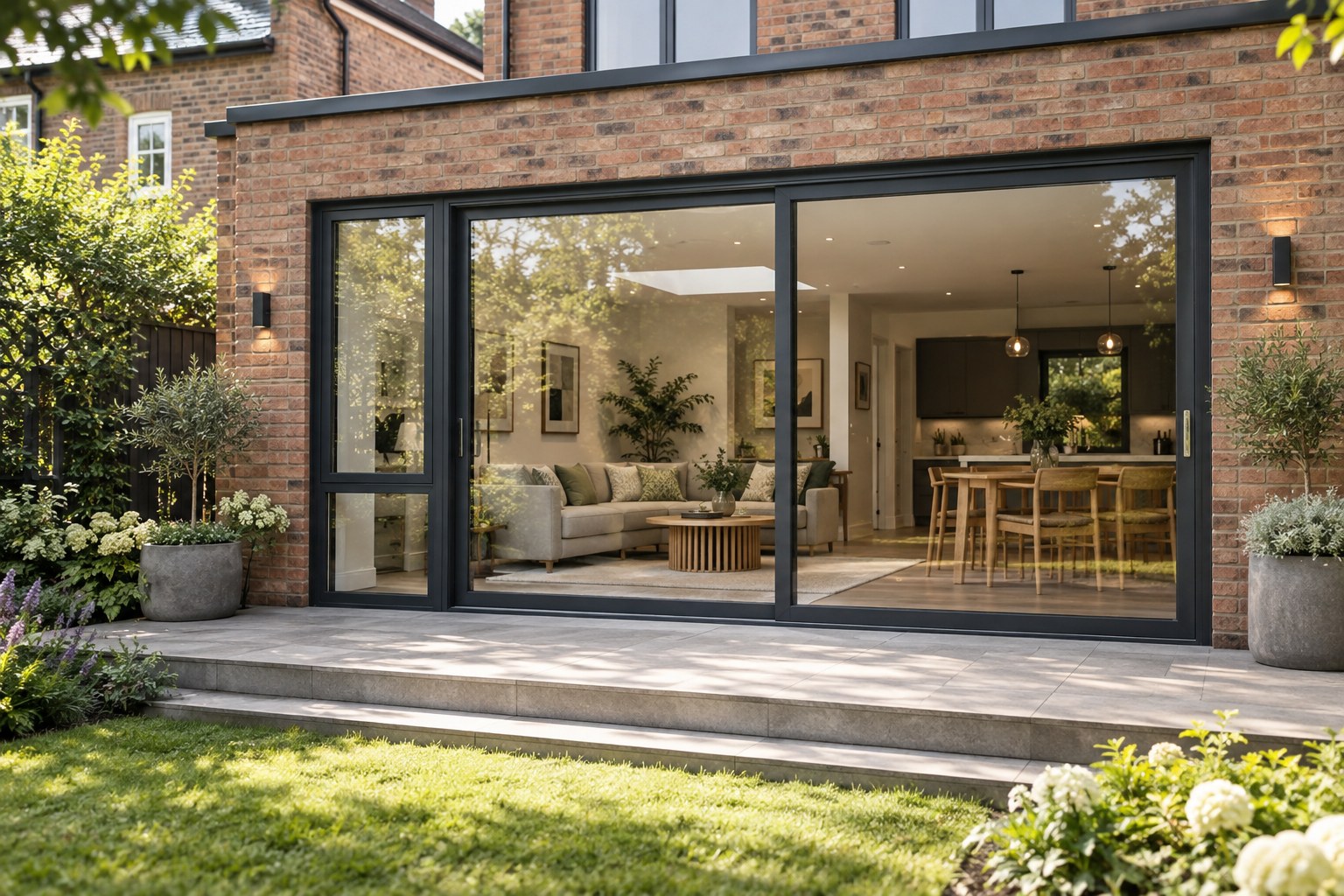
A practical “before vs after” cost simulation using Uw 1.8 → 0.7–0.8 W/m²K (plus what really moves the needle)
In the UK, “running costs” is no longer a vague selling point—it’s a design constraint. Homeowners are comparing monthly direct-debit amounts, developers are defending EPC outcomes, and architects are being asked to deliver comfort and daylight without creating an overheating or maintenance headache. Against that backdrop, upgrading the building envelope—especially windows and doors—often delivers the most reliable, occupant-visible improvements.
For UK homeowners and project teams specifying aluminium windows and aluminium doors, the useful question is how thermal performance translates into running costs. With transparent assumptions, this example shows how the Uw improvement you specified (from Uw ≈ 1.8 W/m²K down to Uw ≈ 0.7–0.8 W/m²K) translates into realistic annual savings for a “typical” UK home, and why the total savings are usually a combination of better U-values + better airtightness + better installation interfaces.
For context, the Ofgem Energy Price Cap for the example period (1 January to 31 March 2026) is set at £1,758 per year for a typical dual-fuel household paying by Direct Debit.
Average cap unit rates over the same period are about 5.93p/kWh for gas and 27.69p/kWh for electricity (rates vary by region).
Ofgem’s “typical household” consumption values are 2,700 kWh electricity and 11,500 kWh gas per year.
1) Uw in plain English: why 1.8 → 0.75 is a big deal
Uw is the whole-window thermal transmittance (frame + glazing + spacers), expressed in W/m²K. Lower is better: it means less heat escaping through each square metre for every degree of temperature difference.
- Uw ≈ 1.8 W/m²K is typical of older double-glazed units or legacy frames.
- Uw ≈ 0.7–0.8 W/m²K is “high performance” territory, often associated with triple glazing and well-designed thermally-broken frames.
Importantly: Part L guidance has pushed the market toward lower U-values over time, and summary guidance commonly references maximum U-values in the ~1.6 W/m²K range for certain replacement window contexts—your target 0.7–0.8 is materially better than that baseline expectation.
So yes—on paper, the improvement is dramatic. The key question is how much that translates into annual bills, which depends on:
- window area and proportion of the envelope
- UK climate (south vs north; coastal vs inland)
- heating system (gas boiler vs heat pump)
- internal setpoint and heating schedule
- airtightness (often the sleeper variable in real savings)
2) The simple simulation method used by energy engineers: Degree Days
A fast way to estimate annual heat loss is to use Heating Degree Days (HDD). HDD aggregates how cold a location is across a year relative to a base temperature. A widely used UK “standard year” HDD at a 15.5°C base is around 2,463.
We’ll use that 2,463 HDD figure to build a clean, reproducible example.
Core calculation (annual transmission heat loss through windows)
For a building element:
- Annual heat loss (kWh) ≈ U × A × HDD × 24 / 1000
Where:
- U is W/m²K
- A is area in m²
- HDD is K·day
- 24 converts days to hours
- /1000 converts Wh to kWh
This is not a full dynamic simulation (it doesn’t model solar gains, wind, or occupant behaviour hour-by-hour), but it’s a very solid “engineering sanity check” that you can adapt quickly.
3) A “typical UK house” window upgrade simulation (before vs after)
3.1 Assumptions (transparent, easy to edit)
Let’s take a common scenario: a 3-bed semi-detached or similar home.
House + glazing assumptions
- Treated window/door glazed area: 20 m² (windows + glazed doors combined)
- This is a representative mid-range figure; many homes will be lower or higher depending on age, extensions, and glazing style.
Thermal performance
- Before replacement: Uw = 1.8 W/m²K
- After replacement: Uw = 0.75 W/m²K (midpoint of your 0.7–0.8 target)
Weather
- UK standard HDD (15.5 base): 2,463
Heating system
- Case A: Gas boiler with seasonal efficiency 90% (reasonable for a modern condensing boiler in good condition)
- Gas unit rate: 5.93p/kWh under the cap average
3.2 Step-by-step: the heat loss reduction from Uw improvement alone
ΔU = 1.8 − 0.75 = 1.05 W/m²K
Annual useful heat saved (kWh):
- = ΔU × A × HDD × 24 / 1000
- = 1.05 × 20 × 2,463 × 24 / 1000
- ≈ 1,241 kWh/year of useful heat
Convert to gas saved (because boiler is not 100% efficient):
- Gas saved ≈ 1,241 / 0.90 = 1,379 kWh/year
Convert to annual cost saving (gas only):
- £ saved ≈ 1,379 kWh × £0.0593/kWh
- ≈ £82/year
Result (Uw effect only): ~£80/year for this representative case.
That number often surprises people because the Uw upgrade is so large. Two reasons:
- Windows are only one component of total heat loss, and
- Real-world savings frequently come from airtightness + interface detailing, not U-value alone.
So the next section is where the simulation becomes more realistic.
4) The “hidden” savings: airtightness and installation interfaces
When homeowners replace old windows, they often gain:
- new gaskets and better sash compression
- tighter frames with less warp / less leakage
- improved perimeter sealing (if installed properly)
In many UK houses with older windows, draughts are a major comfort complaint, and eliminating them can reduce heating demand beyond what Uw accounts for.
A practical way to include airtightness in the simulation
Ofgem’s typical gas use is 11,500 kWh/year.
Not all of that is space heating—some is hot water/cooking—but for a typical household, space heating is usually the dominant share.
Let’s make a conservative assumption:
- Space heating portion: ~75% of gas = ~8,625 kWh/year (assumption for modelling)
- Airtightness improvement from proper replacement: 5–10% reduction in space heating demand (range)
Then gas saved from airtightness:
- Low case: 8,625 × 5% = 431 kWh gas → ~£26/year
- High case: 8,625 × 10% = 863 kWh gas → ~£51/year
Now add the Uw-based saving (~1,379 kWh gas → ~£82/year):
- Total saving (Uw + airtightness):
- Conservative: (1,379 + 431) kWh = 1,810 kWh → ~£107/year
- Stronger case: (1,379 + 863) kWh = 2,242 kWh → ~£133/year
Updated “before vs after” (gas) using Ofgem typical consumption
Using Ofgem’s typical 11,500 kWh gas/year baseline:
- Before: 11,500 kWh
- After (conservative): 11,500 − 1,810 ≈ 9,690 kWh
- After (stronger): 11,500 − 2,242 ≈ 9,260 kWh
Cost impact at 5.93p/kWh (unit rate only):
- Conservative reduction ≈ 1,810 × 0.0593 = ~£107/year
- Stronger reduction ≈ 2,242 × 0.0593 = ~£133/year
This is still only the heating-energy part. It doesn’t include:
- avoided maintenance
- reduced condensation / mould risk
- fewer callouts for stuck doors or failing seals
- improved comfort (often the real reason people proceed)
5) Sensitivity checks: why your results may be higher or lower
5.1 Window area (A) changes everything
If the home has larger glazing (extensions, wide sliders, more glass), Uw savings scale directly with area:
- 15 m² glazing area → ~£60/year (Uw only)
- 25 m² glazing area → ~£100/year (Uw only)
- 30 m² glazing area → ~£120/year (Uw only)
Add airtightness improvements and those totals commonly move into the £120–£200/year range for many households—still not a “magic” number, but meaningful over the service life of good windows.
5.2 Weather: north vs south
HDD varies across the UK and year-to-year. Using 2,463 HDD is a standardised basis.
Colder locations (or colder years) push savings up; milder locations push savings down.
5.3 Heating system type
If you’re on an air-source heat pump, you’re buying heat with electricity. Under the cap average, electricity is roughly 27.69p/kWh.
But a heat pump might deliver ~3 kWh of heat per 1 kWh electricity (COP ~3, varies).
If the window upgrade saves ~1,241 kWh of useful heat/year (from the Uw calculation):
- Electricity saved ≈ 1,241 / 3 = 414 kWh electricity/year
- Cost saved ≈ 414 × £0.2769 = ~£115/year
So: for heat pumps, high-performance windows can protect running costs (because electricity is expensive per kWh), even though the “fuel maths” differs.
6) Why aluminium windows and aluminium doors matter for running costs (not just aesthetics)
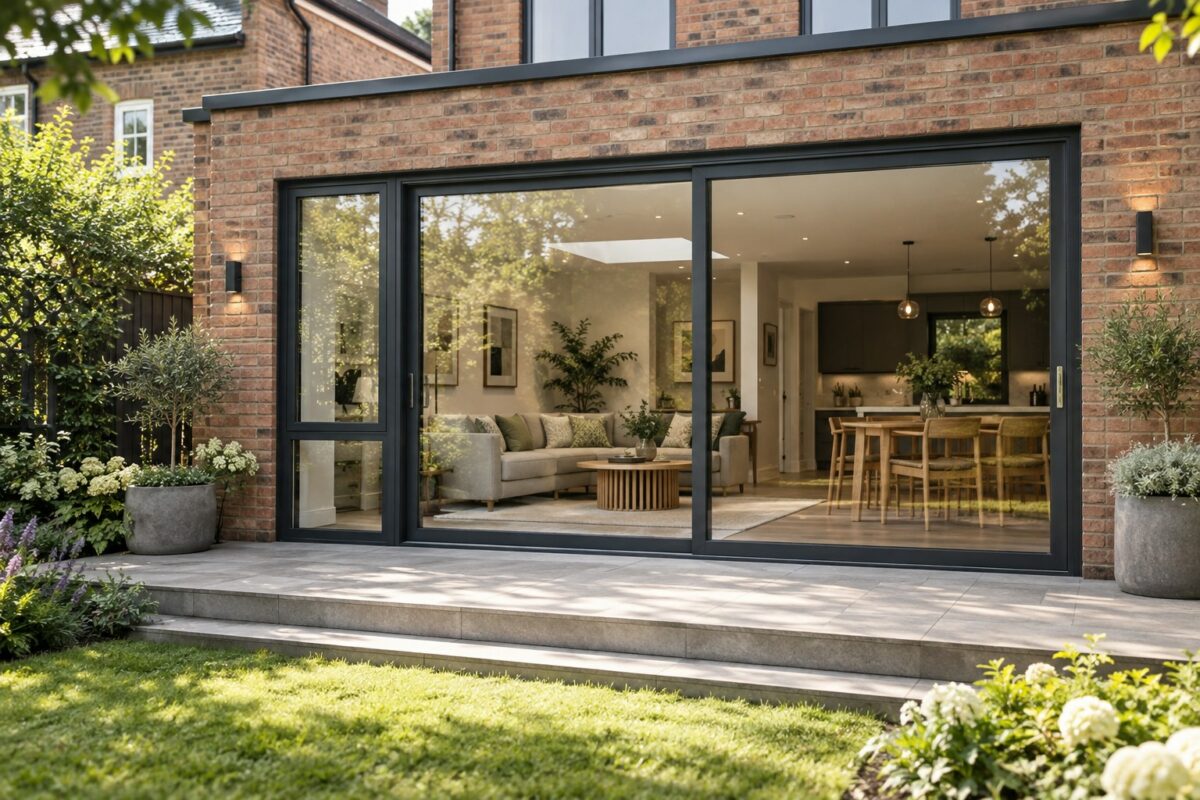
This is the part many articles get wrong: they treat “aluminium” as purely an architectural choice. In practice, modern thermally broken aluminium windows and thermally broken aluminium doors can be a very rational whole-life-cost decision in the UK because they combine:
6.1 Stable geometry = stable seals = stable performance
Energy performance is not only about laboratory Uw. It’s about whether the system:
- keeps gasket compression consistent through seasons
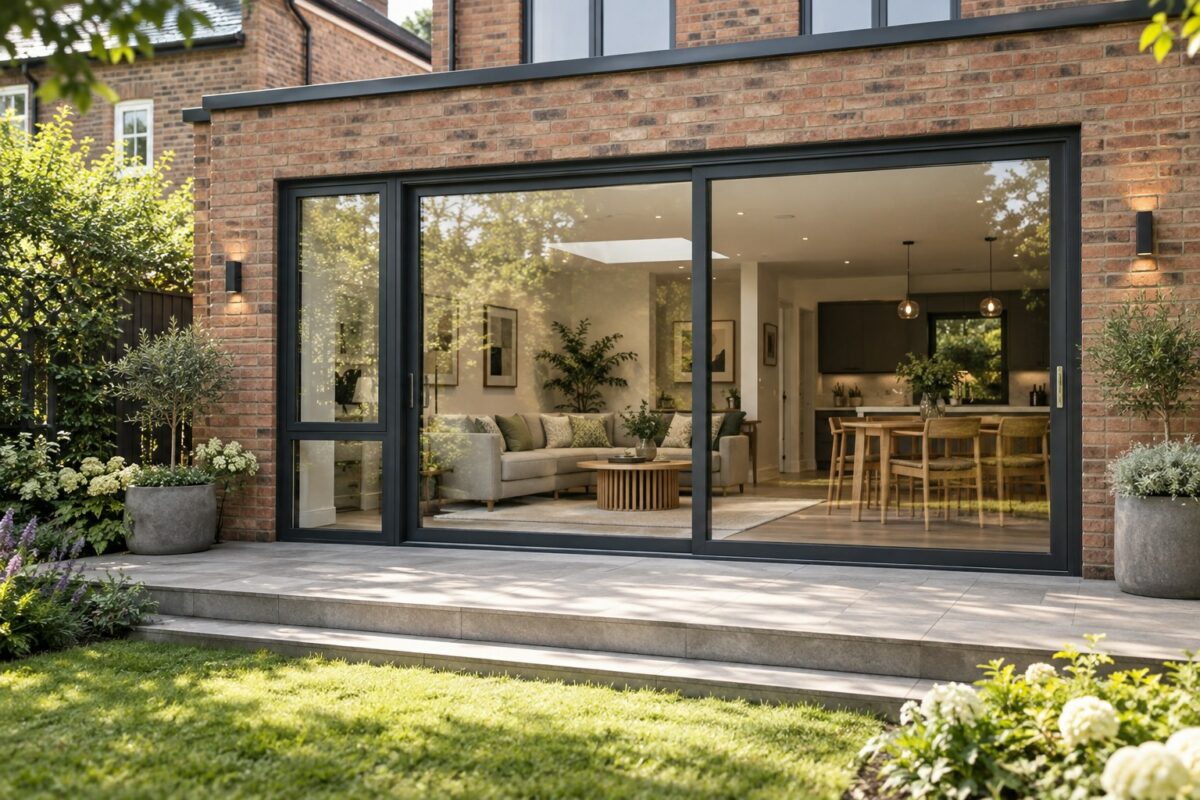
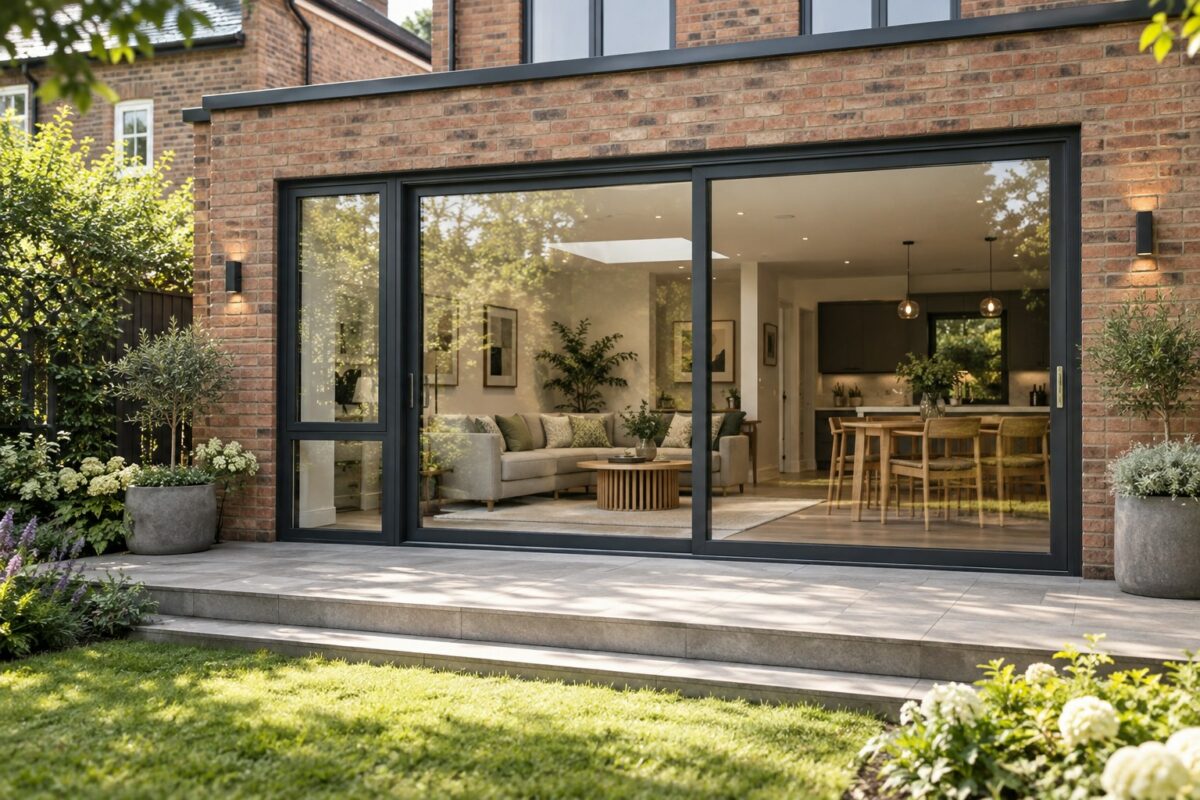
- holds alignment in high-use openings (front doors, patio sliders)
- maintains drainage paths and weathering details under wind-driven rain
Aluminium’s dimensional stability helps reduce the “performance drift” that can show up over time in poorly-supported or heavily-cycled openings.
6.2 Large, heavy glazing done properly
Homes with big sliders and larger panes often need:
- strong frames
- robust hardware
- precise fabrication tolerances
That’s where a capable aluminium window manufacturer / fabrication partner matters, because if fabrication and assembly quality are off by a few millimetres, you can end up with:
- roller issues
- uneven gasket compression
- leaks at thresholds
- lock misalignment (security + user frustration)
6.3 Low maintenance and predictable appearance
Running costs are not only energy. They also include time, repairs, and “small failures” that become annual expenses.
A well-specified aluminium system with durable finishes typically lowers:
- repainting cycles
- corrosion touch-ups
- warped sash adjustments
- premature seal failures
7) Where “aluminium facade systems” enter the running-cost conversation
For refurbishment projects or mixed-use buildings, energy upgrades increasingly go beyond “replace the windows” and into:
- façade over-cladding
- rainscreen upgrades
- curtain wall improvements
- thermal-bridge mitigation at interfaces
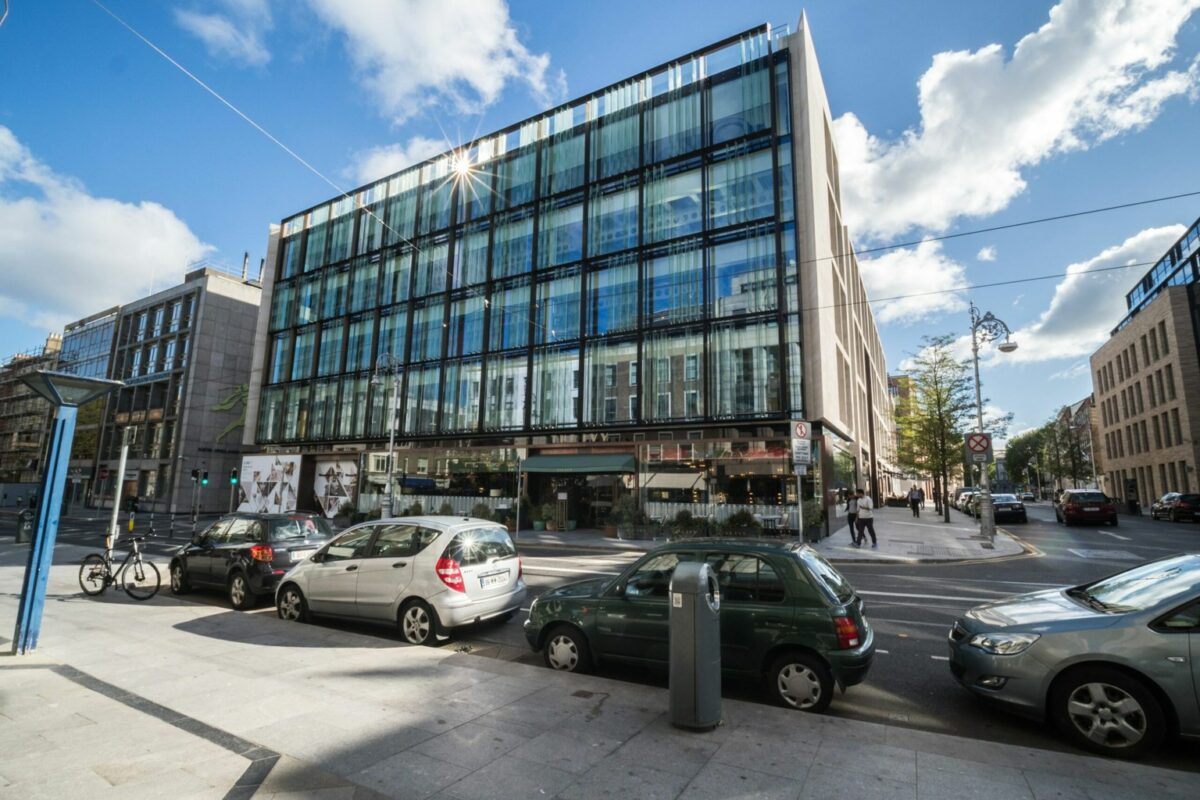
That’s the territory of aluminium facade systems / aluminium facades / aluminium façade systems—not just skyscrapers, but also mid-rise residential blocks and high-end renovations where owners want:
- improved thermal continuity
- better moisture management
- easier maintenance access
- a clean architectural refresh with controlled detailing
From a delivery perspective, this is where off-site fabrication, QA, and repeatable assembly become major cost-control tools.
Alum-Fab’s model is positioned specifically around fabrication support for façade companies across windows & doors, stick curtain wall, unitised curtain wall, and rainscreen, with production set up for these divisions.
For UK projects, this puts predictable production, tolerance management and documentation at the centre of the procurement brief.
8) Guidance: how to specify for real savings (not brochure savings)
If you want the 0.7–0.8 Uw target to translate into actual reduced bills and comfort, these are the levers that matter:
8.1 Specify beyond Uw
Ask for:
- whole-window Uw (not “centre pane” only)
- warm-edge spacers
- suitable solar control where overheating risk exists
- airtightness strategy at frame and perimeter
- robust threshold details for aluminium doors (especially sliders)
8.2 Installation is part of the product
Common failure mode in “energy efficient windows UK” retrofits:
- great windows, poor perimeter detailing
Look for installers who can explain:
- internal air-seal continuity
- external weather-seal continuity
- how they handle uneven reveals and tolerance gaps
- how they avoid thermal bridging at cills/heads
8.3 Measure your own house quickly (so your “simulation” becomes yours)
To personalise the calculation, you only need:
- Approximate window + glazed door area (m²)
- Your current estimated Uw (or age/type proxy)
- Proposed Uw (0.7–0.8)
- Local tariff (p/kWh)
- Heating system efficiency/COP
Then use:
- Heat saved (kWh) ≈ (U_old − U_new) × A × HDD × 24 / 1000
- Cost saved ≈ fuel saved × unit rate
For many homes, a realistic result is:
- Uw effect: tens to low hundreds per year depending on glazing area and region
- Airtightness + better interfaces: often adds a meaningful extra slice
9) Bottom line: what “before vs after” looks like for a typical UK home
Using your Uw assumption and the example period’s cap-level unit rates:
- If a typical home is around 11,500 kWh gas/year (Ofgem typical), a high-performance window/door replacement can plausibly reduce gas use by ~1,800–2,200 kWh/year when you include airtightness gains, not just Uw.
- That equates to roughly £100–£135/year at 5.93p/kWh gas (unit rate only).
- For larger glazing areas, colder regions, or homes currently suffering from significant draughts, the range can move higher.
- For heat pumps, the energy saving converts differently—but can still land around ~£100/year in the worked example because electricity is expensive per kWh.
And that’s only the “bill” side. In real decision-making, many homeowners value:
- fewer draughts
- warmer inner glass temperatures (comfort)
- reduced condensation risk
- easier operation and fewer repairs—especially on large aluminium doors and sliders
For a developer or façade contractor, the next step is to turn the assumptions into an agreed window and door schedule. Alum-Fab’s aluminium window fabrication and assembly services can support that production package; sharing the drawings and performance requirements helps identify where fabrication and installation responsibilities sit. The savings calculated above remain an illustration, not a guaranteed outcome of a particular product or supplier.






 15 Powązkowska St.. 01-797 Warsaw

