


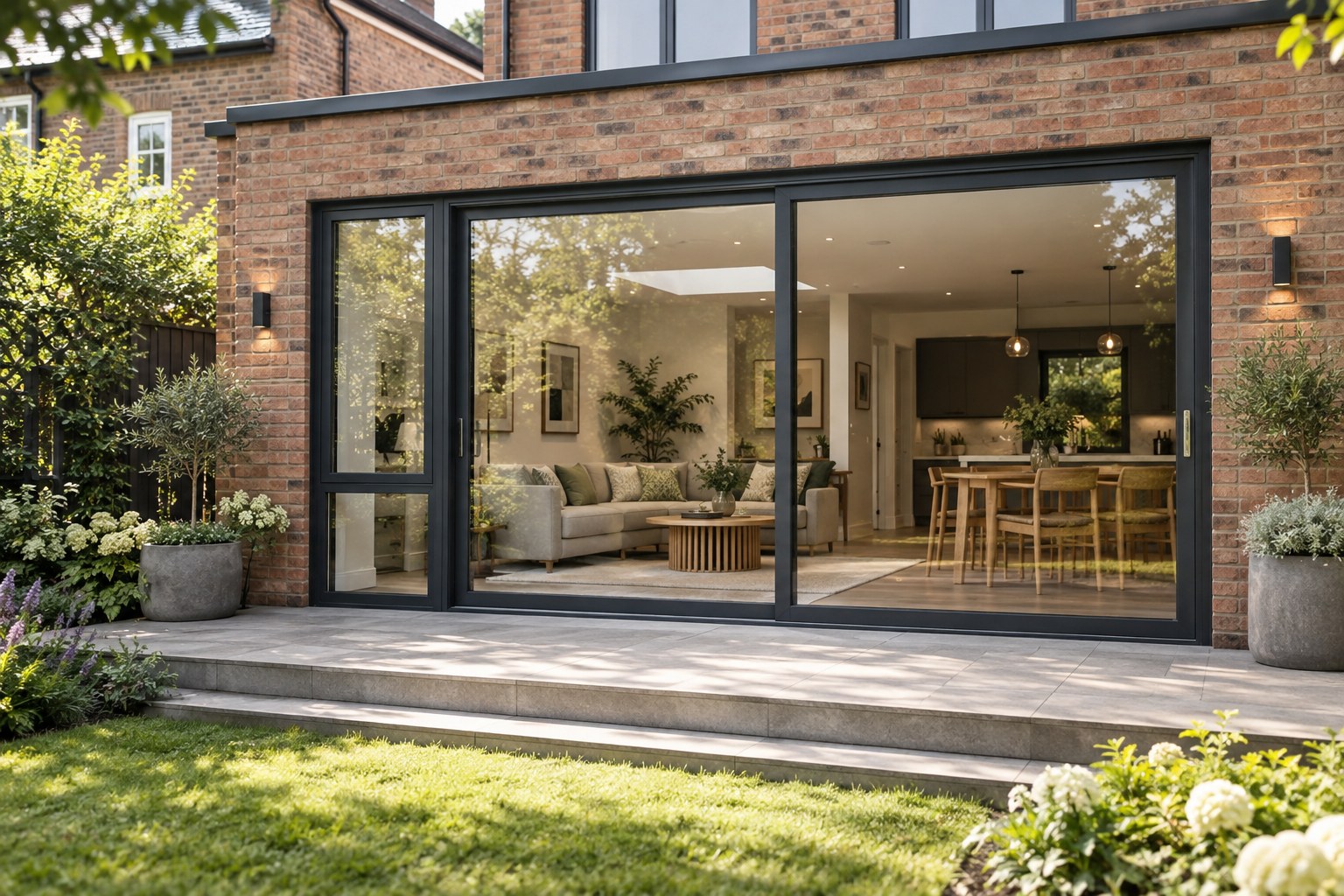
Security has become a mainstream home-improvement driver in the UK. In the year ending September 2025, the Crime Survey for England and Wales estimated a 20% fall in domestic burglary to 342,000 incidents—still a very large number of break-ins affecting households.
Against that backdrop, more buyers are searching for aluminium doors UK, security-rated aluminium windows, and anti-burglar glazing—and they’re finding a confusing soup of acronyms: PAS 24, Part Q, RC2/RC3, P4A/P6B, Secured by Design, plus safety glazing rules under Approved Document K.
This guide untangles those labels in a UK-ready way, with a practical “what to ask for” checklist—especially if you’re looking at thermally broken aluminium windows, modern aluminium doors, or aluminium facade systems for a renovation or new build.
1) UK rules first: Building Regulations security is not “optional” for new dwellings
England: Part Q (Approved Document Q)
For new dwellings (including dwellings created by “material change of use”), England’s Approved Document Q sets the baseline expectation: “reasonable provision” must be made to resist unauthorised access. It focuses on “easily accessible doors and windows” (definition included in the guidance).
Key points you can safely translate into homeowner language:
- Part Q applies to new dwellings only (and certain conversions), not routine like-for-like replacements in existing homes.
- It targets ground floor/basement and other “easily accessible” openings (e.g., within 2 m of accessible ground/balcony; or near low roofs).
- The “default” compliance route in the guidance is testing to PAS 24 (with some listed alternatives).
Wales: Approved Document Q (Wales, 2018 edition)
Wales has its own Approved Document Q (2018), also addressing easily accessible doors and windows, and additionally includes a security lighting section.
Scotland & Northern Ireland
Security requirements are handled differently in Scotland (via Scottish Building Standards guidance) and Northern Ireland (separate building control regime). If your project is outside England/Wales, treat Part Q as a useful benchmark, but confirm local requirements with your designer/building control.
2) PAS 24 vs RC classes: what’s the difference and what matters in the UK?
PAS 24 (UK) — the “Part Q language”
Approved Document Q states that secure doorsets and windows should be manufactured to a design shown by test to meet PAS 24:2012 (the edition referenced in the 2015 ADQ), while noting that similar/better standards may also be acceptable.
In the real market, PAS 24 has evolved since 2012. Police-backed Secured by Design guidance for doorsets references PAS 24:2022 + A1:2024 as the relevant standard in its product requirements.
Practical takeaway:
If you’re buying aluminium doors UK or security-rated aluminium windows for a new dwelling (or you want “Part Q level security” in a refurbishment), ask for PAS 24 test evidence for the exact product configuration you’re being offered.
RC classes (EN 1627) — the “European language”
Across Europe, burglary resistance is commonly expressed as RC classes under EN 1627, which covers burglar resistance for elements including pedestrian doorsets, windows, and curtain walling.
RC classes are helpful when comparing systems (especially for projects that involve aluminium facades / aluminium façade systems and international specifications), but for typical UK residential compliance, PAS 24 remains the most directly legible label.
Practical takeaway:
- For UK housing, PAS 24 is the clearest “yes/no” reference for enhanced security performance.
- RC2 / RC3 can be valuable supplementary information, especially when you want a risk-graded approach.
3) RC class overview (what RC1N–RC6 actually mean for a homeowner)
Manufacturers and test labs use RC classes to represent resistance to progressively more aggressive attempts at forced entry. Keep this high level (and avoid “tool-talk”): the point is risk matching, not an arms race.
- RC1N / RC1: basic deterrence for low-risk situations; typically not what buyers mean by “anti-burglar.”
- RC2: a common target for dwellings—aimed at stopping casual/opportunistic attempts at entry for a meaningful period.
- RC3: elevated protection for higher-risk homes (isolated properties, easy rear access, repeat incidents, high-value contents).
- RC4–RC6: specialist security levels typically seen in commercial/high-security settings rather than normal housing.
Buyer reality: If you see “RC2” on a brochure, ask whether it’s full system RC2 (frame + locking + glazing + installation concept) or something partial (e.g., hardware only).
4) Glass security “P” classes (EN 356): the glazing part of the story
Even the best frame and locks can be undermined by weak glazing. That’s where EN 356 “P” ratings come in: they classify resistance to manual attack for security glazing.
EN 356 splits into two families:
- P1A–P5A: tested using a hard-body drop (a steel sphere) to represent blunt impacts; the glass must resist penetration.
- P6B–P8B: higher resistance levels involving repeated impacts followed by cutting through the interlayer (a more severe test regime).
What should a UK homeowner typically target?
For many homes, P4A is often discussed as a practical “security glazing” baseline for vulnerable locations. In some industry guidance, P4A is explicitly referenced as a typical glazing class used with RC2 windows.
But here’s the critical nuance:
A glazing “P class” is not automatically the same thing as a secure window/door certification (PAS 24 or RC2). You want the complete assembly to be tested/certified, not just “good glass in any frame.”
5) Don’t confuse “safety glass” with “security glass” (UK Approved Document K matters)
UK home safety isn’t only about burglary. Glazing also has to protect occupants from injury in critical impact locations.
Under Approved Document K (England), glazing in critical locations is suitable if it meets specified BS EN 12600 impact-safety classes (e.g., Class 3 generally, or Class 2 for door/side panel situations with wider panes), or the older BS 6206 equivalents.
Why this matters in real specs:
- A pane can be impact-safe (meets Approved Document K) yet still not be meaningfully burglar-resistant.
- Conversely, security glazing often ends up being laminated, which can also help with safety performance—but you still want the correct certification for the use case.
Good practice request: Ask your supplier/installer to confirm both:
- Impact safety compliance (Approved Document K / BS EN 12600), and
- Security performance (PAS 24 and/or RC class + EN 356 glazing class where relevant).
6) “Anti-burglar” performance is a system outcome (frame + hardware + glass + installation)
A secure product is not “one feature.” It’s a chain, and the chain fails at the weakest link:
(a) The frame and thermal break
Modern thermally broken aluminium windows and doors can be both energy efficient and highly secure. The thermal break is about insulation, but aluminium’s inherent rigidity helps engineers build robust corner joints and stable lock engagement—especially important for larger formats and minimal-sightline designs.
(b) Hardware and locking
You’ll see terms like multi-point locking, hinge protection, security cylinders, and lock standards. Approved Document Q is explicit that openings need to be robust and fitted with appropriate hardware.
For doors, this is particularly relevant to:
- the quality of the locking system,
- the cylinder and handle set,
- hinge-side protection,
- the integrity of the threshold and keeps.
(c) Glazing retention and bead security
A surprising number of failures in the real world come from poor glazing retention detail or incorrect installation. This is another reason to prefer PAS 24 certification, because it tests the assembly rather than trusting that components will “add up.”
(d) Installation (often the real failure point)
Approved Document Q requires window frames be mechanically fixed to the structure in accordance with manufacturer installation instructions.
A security-rated product installed badly is no longer security-rated in practice.
7) Security for aluminium doors UK buyers: what to specify by door type
Front entrance doors (single or double)
For most UK homes:
- Target PAS 24 (latest edition available from the supplier) for the doorset.
- Confirm safety glazing where relevant (Approved Document K).
- If you want a rating “ladder,” consider RC2/RC3 equivalents for higher-risk contexts (ask for certification evidence).
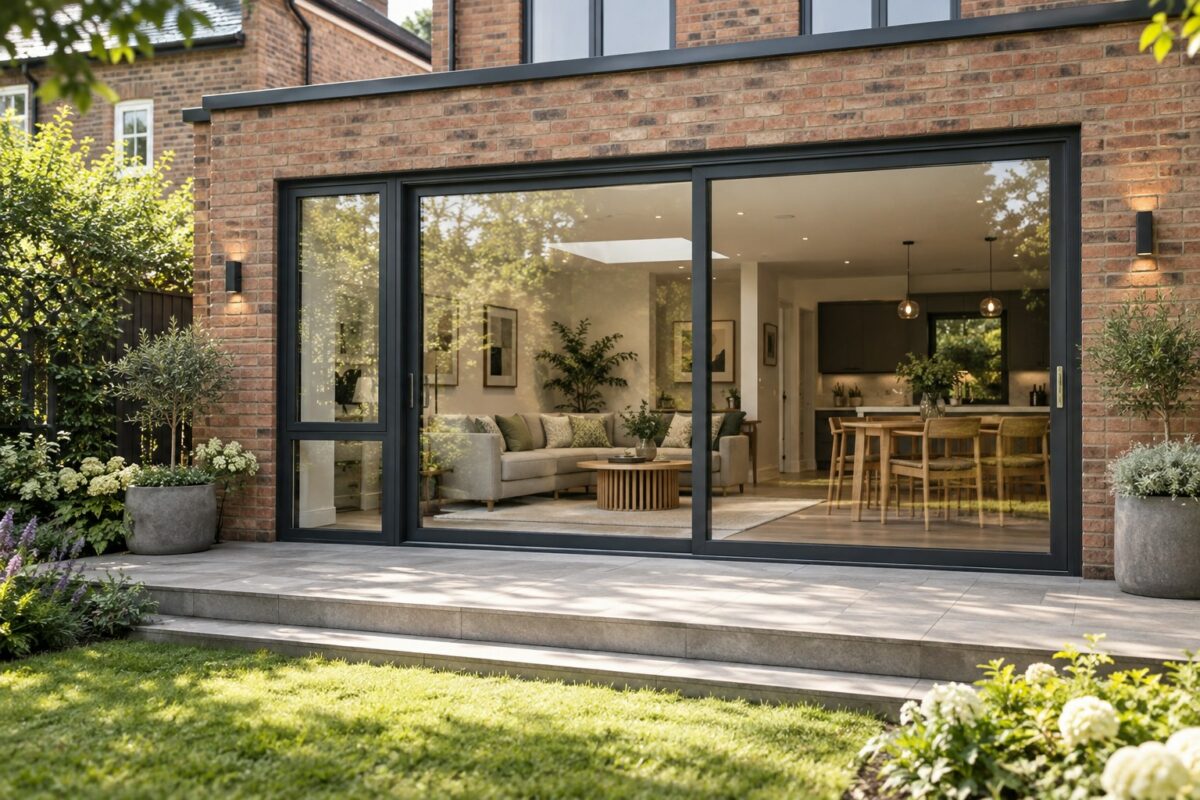
Patio sliders / lift-and-slide
Sliding doors are often large and heavily glazed—excellent for daylight, but they demand correct specification and installation discipline. Ask specifically:
- Is the exact slider configuration tested/certified (not just “the system family”)?
- What’s the glazing class (EN 356) on vulnerable elevations?
Secondary doors (side/rear)
Rear access is a common homeowner concern. Treat these doors as “front door important” in spec terms—especially if they’re easily accessible.
8) Security for aluminium windows: ground floor, basements, rooflights, and “easy access” logic
Approved Document Q is very clear that security attention goes to ground floor, basement and other easily accessible windows, including rooflights.
So your security priorities should follow the building geometry:
- Ground floor & basement: strongest spec focus.
- Near flat/low-pitch roofs: treat as accessible.
- Upper floors: still consider safety glazing and child safety (different topic), but burglary resistance is typically prioritised lower unless there’s unusual access.
9) Aluminium facade systems and apartment blocks: what changes?
If you’re looking at aluminium facade systems (stick curtain walling, unitised curtain walling, or rainscreen with integrated windows/doors), the project often sits between “residential” and “commercial” security approaches.
Approved Document Q itself lists alternative standards that can be used to demonstrate similar/better performance than PAS 24, including LPS 1175 and other schemes.
In practice:
- Ground floor façades, communal entrances, and doorsets may require higher assurance.
- Certification routes may involve LPCB/LPS schemes on some projects.
10) UK buyer’s checklist (copy/paste this into your email to suppliers)
Use this when contacting an aluminium window manufacturer, an aluminium door manufacturer, or an installer:
Copy/paste template:
Please confirm the security and safety performance of the proposed aluminium windows/doors (include the exact system, hardware set, glazing build-up and opening sizes):
- Security: evidence of testing/certification to PAS 24 (current edition) for the complete doorset/windows assembly (or an accepted equivalent).
- If available, provide RC class certification to EN 1627 for the same configuration.
- Glazing: confirm EN 356 “P” class where security glazing is proposed (e.g., P4A or higher as applicable).
- Safety glazing: confirm compliance with Approved Document K / BS EN 12600 for critical locations.
- Installation: confirm mechanical fixing method and that installation follows the certified/tested configuration and manufacturer instructions.
This single message forces clarity and filters out vague marketing.
11) Where Alum-Fab fits in a security-focused procurement
If you’re sourcing internationally or working with façade contractors, it helps to choose a partner that understands system compliance and correct assembly. Alum-Fab describes itself as providing professional production management and assembly of aluminium systems, with capability across windows & doors, stick curtain walling, unitised curtain walling, and rainscreen cladding, including fabrication of major system houses (e.g., Schüco, Aluprof, Reynaers, Hydro/Wicona) depending on project needs.
On the doors side, Alum-Fab states its doors are manufactured using system solutions from well-known manufacturers and can be specified with brand hardware and optional access control features (e.g., fingerprint reader/remote control), which can form part of an overall home security strategy when correctly designed and installed.
(As always: ask for the actual certificates for the exact configuration you’re buying.)
12) Bottom line: what “good” looks like for most UK homes
For a typical UK home aiming for meaningful burglary deterrence without going overboard:
- Doors and easily accessible windows: prioritise PAS 24-tested assemblies (current edition evidence), aligned with the Part Q logic for “easy access.”
- Glazing: use EN 356 P-class intelligently (often P4A as a practical baseline in vulnerable locations, higher if risk demands), but never as a substitute for assembly certification.
- Safety: don’t forget Approved Document K / BS EN 12600 for critical impact locations—security and safety are different requirements.
- Installation: insist on correct mechanical fixing and adherence to the tested/certified configuration.
For a façade contractor, a useful next step is to share the window and door schedule with Alum-Fab and agree the aluminium fabrication and assembly scope against the specified system. The exact test evidence, hardware and installation details should travel with that brief; a familiar system-house name alone does not establish the security rating of the completed assembly.






 15 Powązkowska St.. 01-797 Warsaw

